
BioJet
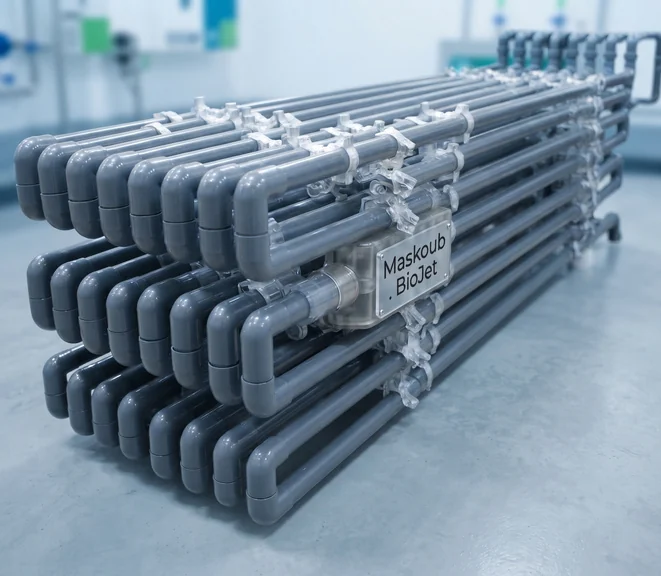
BioJet is a modular treatment unit made up of a set of compact tubular bioreactors assembled on a single skid. A fully enclosed biological treatment system, it prevents sludge accumulation and operates automatically without chemicals.
 90–97%removal BOD/COD/TSS15 dBNoise level4 m²per unit 10 m³/d
How it works BioJet
The system operates in plug flow inside locally manufactured HDPE or PVC pipes. A biofilm forms on the inner pipe wall, capturing organic matter and removing it from the water.
Water is recirculated within the unit for two to three hours until the organic matter is consumed, so the system needs no settling tanks and discharges negligible suspended solids or sludge.
Pumping and pre-screening
Raw water is pumped from the wet well and passes through a hydrocyclone to remove large solids.
Receiving tank
The pretreated water enters a secondary receiving tank.
Venturi aeration
Water is driven into the reactor lanes through a Venturi aeration unit.
Biofilm formation
As aerated water circulates in the pipes, the biofilm forms and grows.
Recirculation
Water is recirculated continuously until the organic matter is fully consumed, and the biofilm then self-regulates.
Filtration and disinfection
Treated water passes through a cloth filter, followed by optional UV or chlorine disinfection.
Key advantages
Very low energy
No mechanical parts other than the feed and recirculation pumps.
Enclosed and odor-free
A sealed, silent system that emits no odors.
Chemical-free
Fully biological treatment with no chemical additives.
Near-zero sludge
1 kg per 1000 m³ of treated water only.
Automatic and remote control
Fully automatic operation with a remote-control option.
Ideal for tight spaces
Suited to decentralized applications and space-constrained sites.
Technical specifications
| Design capacities | 10, 20, 50, 100, 500 m³/day — expandable in modules of 500 m³/day |
|---|---|
| 48-pipe module | 8 parallel lines × 6 pipes, 6 m each — batch volume 1.48 m³ |
| Biofilm attachment area | 437.5 m² (pipe walls + bio-media at 550 m²/m³) |
| Operating cycle | Fill 30 · circulate 120 · drain 30 min — about 8 batches per day |
| Aeration | Self-priming venturi — no compressor or blower |
| Pumps & power supply | Feed + 2 circulation pumps, 0.75 kW each · 220 V · 50 Hz |
| Control | PLC with conductive level sensors, timers and protection alarms |
| Power demand | ≈ 400 W/m³ |
| Unit dimensions (10 m³/d) | 7 m L × 0.6 m H × 0.6 m W |
| Required footprint (10 m³/d) | 4 m² |
| Noise level | 15 dB max. |
| Odors | None |
| Removal efficiency | BOD, COD and TSS: 90–97% |
| Sludge production | 1 kg / 1000 m³ |
| Materials | HDPE or PVC |
Applications
From the Maskoub stand at AquaEnergy Expo
“Water goes through a filtration stage, then circulates inside the pipes, and a biological film forms that takes up the organic matter. We don't need clarifiers, and no sludge comes out.”
Photos & drawings
Learn more about BioJet
A detailed technical guide and a brochure to share with your team.
Related products
 Biological Treatment
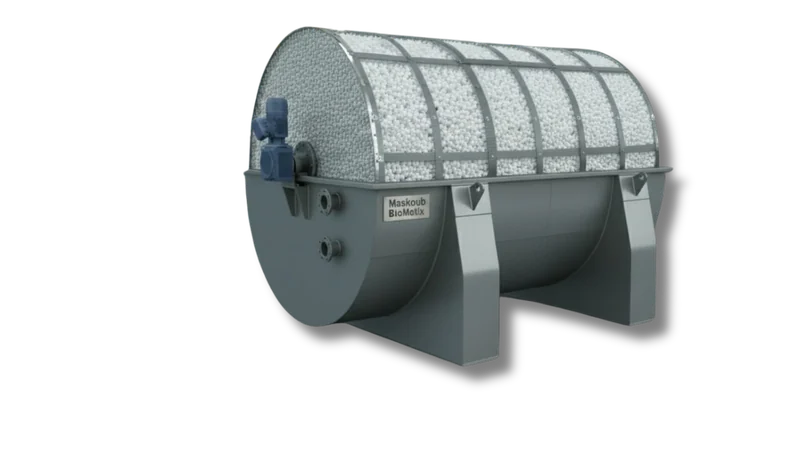
BioMotix
Rotating biological treatment unit with 3D biomedia; the large model treats 500 m³/d using only about 1.8 kW.
DetailsBiological TreatmentBioMotix-Anoxic
A BioMotix application for anoxic conditions, within a treatment system targeting nitrate removal…
Details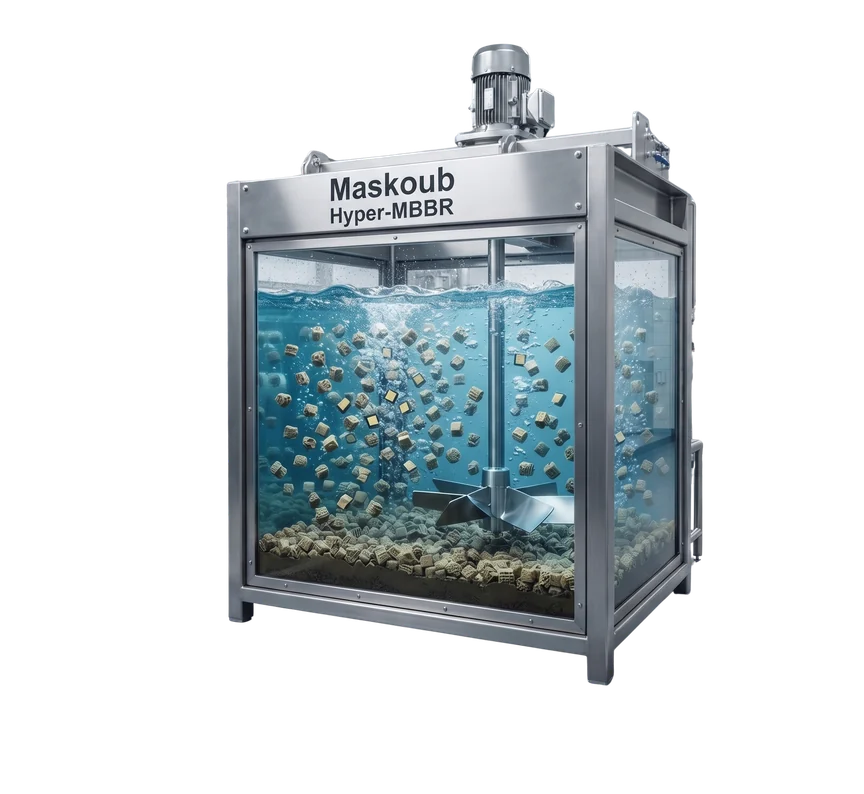 Biological Treatment
Hyper MBBR
Decouples mixing from aeration in MBBR reactors, reducing energy consumption and stabilising the biofilm.
Details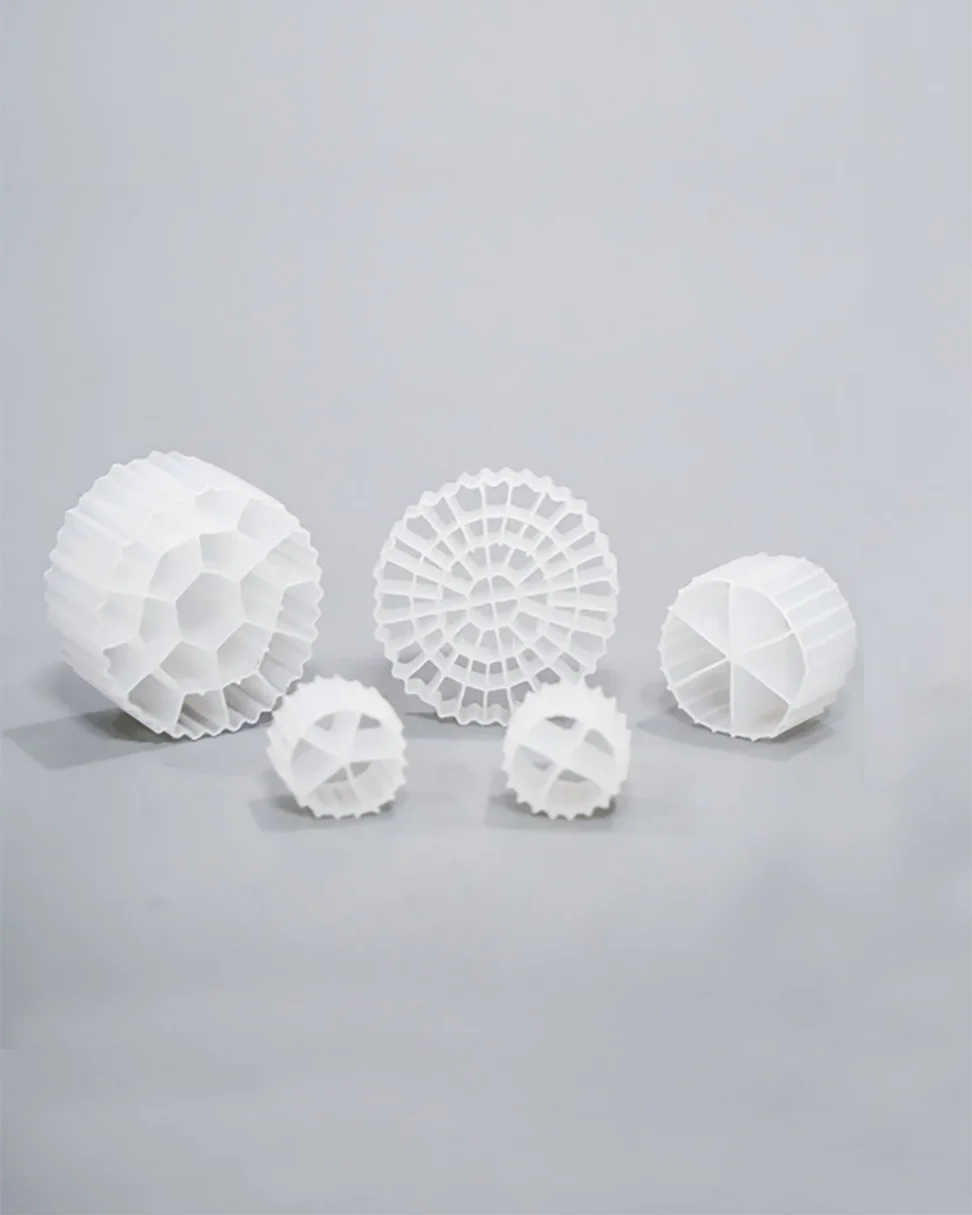 Biological Treatment
MBBR Bio Media
HDPE media with a specific surface area of 550 m²/m³ and UV resistance, for MBBR and IFAS reactors.
DetailsIs BioJet right for your project?
Send your water data, flow and target, and our team will assess the most suitable solution and prepare a technical proposal for you.